June 8, 2017

EDET 677 Mech App Week 4 Blog

EDET 677 Mechanical Applications
Week Four Blog
Essential Question: What project could help me integrate my content with making?

            I have found it very difficult to think of a project that connects to the high school mathematical standards. I would like to let my students have some originality in their creation but still be able to cover required concepts in their high school math classes. Also it is important to give students the opportunity to physically make something that can be relevant to them. After reviewing the math standards and talking to a few friends, I have come up with a project that I would like to try with my students someday mainly because I am excited to see what type of ideas my students will come up with.

            Students will be presented with different types of products that are odd shaped such as a coffee mug, a t-shirt, basketball, dance fans, local goods, etc. The students will make packaging for whatever two items they want to and they will have access to different types of packaging materials such as cardboard, Styrofoam, plastic, tape, etc. They will make the packaging with selling the product in mind so they will need to keep in mind of cost, appearance, ease of opening the packaging, ease of shipping, and eco-friendly. There will be various conditions of each material chosen such as “You have picked packaging that is eco-friendly therefore you get a 10% increase of sales.”

            This project does meet the criteria laid out by Martinez and Stager on the elements of a good project for students to do in a maker sense.

1. Purpose and Relevance. Students will be able to decide what product they want to package and what materials and design they want to use in packaging the product. Students are interested on how to make the most money by having the most efficient packaging that is best for the product.

2. Time. I plan to give students between two to three weeks in starting their first set of packaging. Then I would challenge all students to improve upon their packaging with some suggestions and 2 more weeks would be given. Then students would be given about 1 more week to conclude their project with a presentation and proposal to a company.

3. Complexity. This project provides opportunity to combine the subject areas of mathematics, economics, business, ethics, art, and language arts. Language arts is the subject area that is not as easy to connect but in my assessment, students will need to write an argumentative “essay” on how their packaging is beneficial for the company to use.

4. Intensity. There will be so many variables connected to this project that students can spend lots of time on finding the absolute best way to package their product.

5. Connection. Students will be able to exchange ideas and opinions on the packaging that they are creating. I would encourage students to go to stores and see what is already created and ask questions on how well different products ship or the ease of opening of the packaging. If students are working with a local company, artist, or business, then they can have a connection with the community.

6. Access. This might be the most difficult part to provide to students. The materials might not be completely authentic but I would hope to have at least 7-10 different types of materials for packaging. To get these materials I would ask teachers, parents, and local stores to provide any extra materials or recycle some already used materials.

7. Shareability. Students will be able to share with each other and connect in this because everyone has a similar project. If students are working with local people and businesses then they can share with them.

8. Novelty. How great would it be if students were able to provide a new design to a company that might benefit them!

            The potential mathematical standards that can be covered are as followed:

G‐GMD.3.  Use volume formulas for cylinders, pyramids, cones, and spheres to solve problems. For example: Solve problems requiring determination of a dimension not given.*

G‐GMD.1. Explain how to find the formulas for the circumference of a circle, area of a circle, volume of a cylinder, pyramid, and cone.

A‐CED.1. Create equations and inequalities in one variable and use them to solve problems. Include equations arising from linear and quadratic functions, and simple rational and exponential functions.

N‐Q.1. Use units as a way to understand problems and to guide the solution of multi‐step problems; choose and interpret units consistently in formulas; choose and interpret the scale and the origin in graphs and data displays.

N‐Q.2.  Define appropriate quantities for the purpose of descriptive modeling. 


6.G.2. Apply the standard formulas to find volumes of prisms. Use the attributes and properties (including shapes of bases) of prisms to identify, compare or describe three- dimensional figures including prisms and cylinders.

7.G.6. Solve real-world and mathematical problems involving area, volume and surface area of two- and three-dimensional objects composed of triangles, quadrilaterals, polygons, cubes, and right prisms.


            To assess the standards that are used in the project, I will have a summative assessment of presenting to their classmates by explaining they have learned each standard. The volume and surface area standards will be assessed by looking at the calculations of these and assessing of it being correct or not. A rubric will be created that students are allowed to show understanding in whatever means they think to be best.

Resources:


Martinez, S. L., & Stager, G (2013). Invent to Learn: Making, Tinkering, and Engineering in the Classroom. Torrence, CA: Construction Modern Knowledge Press.

June 6, 2017

EDET 677 Mech App Week 3 Reflection

Building our robot to make sound was great! I had never done anything like this. It was a little bit awkward to do this together over Google Hangout but I just think I need to get used to some silence where everyone is working. The one part that I found interesting is that if we are missing a piece or we accidentally break something, then its difficult to rig something together to be able to continue with the building. I really liked how we got to code but it is a bummer that we don't really look at what each line means and does. Maybe it does a bit more in the book but it would be great if we talked about it in class.

My classmates had some great points to make about struggling students and I really appreciate how most said that each student is different therefore we can't say a blanket statement of how much they should struggle in class. When it comes to coding, there have been many times my students were struggling and then became frustrated. I reminded them that we are all learning and one little mistake will mess up the whole thing but we are capable of finding that mistake.

EDET 678 Emerge Tech Week 3 Reflection

I missed class for twitter therefore I did not add into the conversation. With that said, project based learning is very interesting to me. When students apply their learning to a certain goal or project, then they learn with more motivation because they have an ending goal. I definitely think it can be applied cross curriculum. It is daunting when thinking about setting up a class like that. For me to really feel comfortable with project based learning I would need to see how the standards and content of the class fit in to the project. This can be a lot of information to figure out.

I was surprised by how many of my classmates preferred a flipped classroom over genius hour and MOOCs. I am very passionate about MOOCs and I think its because I have seen it work in my own classroom. Flipped classrooms seem too daunting for my students at school and honestly, for myself because of making videos and/or finding videos to connect to each piece of content. I like the idea of Faux Flip by having a soft assignment of learning something before class so that we can do lots of practice in school. I think I will start trying this and see how it goes.

June 2, 2017

EDET 678 Emerge Tech Week 3 Blog

EDET 678 Emerging Technologies Week 3 Blog
Essential Question: Which emerging pedagogy appeals most to you, and might be most useful for your classroom and students? Why?

            The emerging pedagogy that most appeals to me out of flipped classrooms, MOOCs, and genius hour is MOOCs (Massive Online Open Courses). MOOCs might be the most useful for my classroom because it can provide topics that I am not an expert in or that my school can’t provide. I have used an open online course from Harvard for two-three weeks to fill in some extra time at the end of the school year. I wanted to expose my students to computer science and the process of coding. This was a big task for me because I had no idea where to start and really didn’t have the skill set that I was wanting for my students to learn. Therefore, I used the materials and resources of a MOOC from a course that I have heard positive reviews from teachers in Alaska. Having this course for my students and I to learn was something that the District could not provide for my students or me.

            Bock and O’Dea bring concern of MOOCs that they don’t provide differentiate instruction for students and I agree with this (2013). K-12 schools do have a responsibility to reach all students and to help all students learn in the environment that is best for them. If students take MOOCs on their own, they will need to be students who are motivated intrinsically. Thompson describes MOOCs to be helpful for AP courses or for students who are used to learning more on their own (2013). This is true about most online courses anyways. I think this is where in K-12 we have the flexibility to support students in MOOC courses by supplementing instruction when needed or providing information in a different manner. I see MOOCs as a flexible way to learn some great material because it is free to everyone, including teachers, therefore teacher and student can be learning together and supporting each other in these courses.

            The other two emerging pedagogies did not quite fit well with my classroom and my personal goals for each class. Flipped classrooms require students doing work at home and for some students, there is not a stable environment for them to be doing schoolwork. Genius hour is a great idea but after reflecting on it for a day, I am not 100% sure I can model it correctly in my math classroom because I would want students to pick something that interests them that is connected to math. This would be limiting students their desired learning topics.

Resources:

Bock, M. & O’Dea, V. (2013). Virtual educators critique value of MOOCs for K-12. Education Week. Retrieved from http://www.edweek.org/ew/articles/2013/02/06/20moocs.h32.html


Thompson, G. (2013). Get ready: MOOCs are coming K-12. The Journal. Retrieved from https://thejournal.com/articles/2013/09/02/get-ready-moocs-are-coming-to-k-12.aspx

June 1, 2017

EDET 677 Mech App Week 3 Blog

EDET 677 Mechanical Applications of Technology
Week Three Blog
Essential Question:  To what extent should we allow students to figure things out for themselves?

            Even though I didn’t finish school too long ago, graduated high school in 2010, I was taught in a very traditional manner especially when it came to mathematics. To me this included that material was presented to me not discovered through an activity and not very often did I have to come up with main ideas on my own. Also, I never really struggled with the subject until I got to college when professors weren’t as able to (or willing to) help me with my computations and the higher order processing skills that go along with it. Therefore, I did learn how to struggle but it wasn’t the best experience for me at that time. As a math teacher I must make a point to not help a student when they are struggling to figure out a math problem. Even if I ask the student and they say no, it is very tough for me to walk away and let the student try on their own. Even if it is difficult for me to do, I do think that teachers need to let students struggle on a regular basis or figure out concepts being learned in class on their own.

            Seeley explains that students should go through a constructive struggling stage versus a pointless frustration stage. “Constructive struggling can happen when a skillful teacher gives students engaging yet challenging problems.” (Seeley, 2013) To provide students with constructive struggling, teachers shouldn’t give remote short problems but rather a longer more difficult problem that is supported with the correct questions to lead learning if necessary. I agree with Seeley that the classroom needs to have more constructive struggling for students because the struggling can help develop other skills such as perseverance, endurance, creativity, collaboration, and other skills that might not be taught or practiced if students didn’t get the chance to struggle in class.
            STEAM is an acronym that stands for science, technology, engineering, art, and mathematics in education. STEAM courses provide many ways to improve thinking processes. Struggling is important for creating something to solve a problem so that students can go above and beyond to solve it. Martinez and Stager provide some thinking processes that are much more applicable than the linear and traditional scientific process. These thinking models include the Spiral Design, Iterative Development, Resnik’s Imagine Create Play Share Reflect, and TMI (think, make, create). (2013)
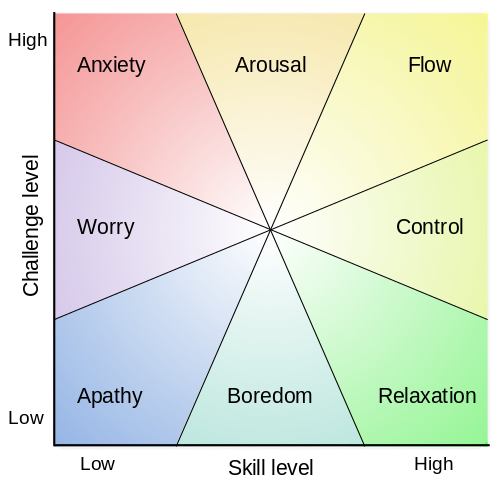
            There is an art to what extent we let our students struggle in respect to the level of the students skill set. Looking at the figure below provided by Seeley, the most learning is happening for high level skilled students when the challenge level is high, for middle level skilled students need medium to high challenge level, and for low level skilled students need to focus on skills and have some strong guidance (2009). See the figure below.

Resources:

Martinez, S. L., & Stager, G (2013). Invent to Learn: Making, Tinkering, and Engineering in the Classroom. Torrence, CA: Construction Modern Knowledge Press.

Seeley, C. L. (2009). Constructive Struggling: The Value of Challenging Our Students. From Faster Isn’t Smarter: Math Solutions. Retrieved from http://www.mathsolutions.com/documents/9781935099031_message17.pdf

Strauss, V. (2015). What is the value of letting students struggle in class? Teachers answer. The Washington Post. Retrieved from https://www.washingtonpost.com/news/answer-sheet/wp/2015/04/21/what-is-the-value-of-letting-students-struggle-in-class-teachers-answer/